Focus & breaks
The 40-second break
What a short look at something calm does for your focus, and why I built Ambient New Tab for my ADHD brain.
A 40-second look at something green can sharpen your focus for the next stretch of work. That is what researchers found when they tested it, and it is the reason I built Ambient New Tab.
Most of us now spend the day reading on screens. Articles, emails, documents, one tab after another. For some brains that is fine. For mine, it never was. I can do the work, but not straight through. I need a release valve.
How my brain works
As a kid I did the usual things. Class, sports, bikes, running around. But when the task was a book report, studying for a test or reading an article, my mind drifted. I could do the work. I just couldn't do it in one long push.
I'd read a page, then daydream. I doodled in the corners of my pages: comic book characters, spaceships, circles, cubes, alien space fighters. That's how my brain worked. My grades were okay, but everything needed a release valve after a while. I needed to get up, move my body and give my mind something to stretch on.
I didn't know what it was. I didn't think anything was wrong with me, and I still don't. Then I found out I had ADHD. As a child I didn't understand what that meant.
Doctors suggested medication. My mother chose a different path for me: she saw the creativity in how I thought, and she put me in art class, baseball and basketball. She understood how my mind worked. That was my family's decision. Medication helps a lot of people with ADHD, and it's a choice for each person to make with their doctor.
I did struggle in school, mostly with paying attention. I'm also dyslexic, so dry black-and-white text was hard. As I got older I learned my style. I'm an audio learner: give me an audiobook or a documentary and I take it all in. I'm a visual learner too.
Today I work in business and investing, and I have the same brain. If there's a pen in my hand, I still doodle in the margins. I still daydream a lot. I've come to see daydreaming as an important part of how I think, and I never want to lose my creativity or imagination.
Do short breaks actually help you focus?
In 2015, researchers at the University of Melbourne gave 150 students a dull task: press a key every time a number flashed on screen, except when the number was 3. Halfway through, everyone got a 40-second break to look at a picture of a city rooftop. Half saw a rooftop covered in a flowering meadow. Half saw bare concrete.
The students who saw the green roof made significantly fewer mistakes afterwards and kept their concentration better. Forty seconds. The lead researcher, Dr Kate Lee, put it simply: "just a moment of green can provide a boost for tired workers." (Lee et al., 2015)
That is one study, so I don't want to oversell it. But it fits a bigger picture. In 2022, a team in Romania pulled together 22 studies on "micro-breaks", meaning breaks of 10 minutes or less. Across them, short breaks were linked to more energy and less fatigue. They didn't boost every kind of performance, but longer breaks tended to help with creative and routine tasks. (Albulescu et al., 2022)
In plain terms: a short, real break can leave you less drained. It doesn't need to be long.
Is daydreaming bad for focus?
Daydreaming isn't slacking. For years, it was treated as a failure to pay attention. Psychologists have pushed back on that. A 2013 review described "positive constructive daydreaming": the kind of mind-wandering linked to creativity, planning and imagination. (McMillan et al., 2013)
There's newer, early research on ADHD too. In October 2025, a team at Radboud University presented two studies with about 750 participants. People with more ADHD traits scored higher on creativity. Letting your mind wander on purpose was linked to imagination, while drifting off without meaning to was linked to the everyday struggles of ADHD. These results haven't been peer-reviewed yet, so treat them as a promising lead, not a settled fact. (HealthDay, 2025)
That difference matches my own life. When I choose to drift for a minute, I come back with ideas. When I drift without meaning to, I lose the thread.
Why I built Ambient New Tab
We all have to read and work online, a lot. I wanted something that gave me a mental break from time to time, right where I already am: the new tab.
So I built Ambient New Tab. Every time you open a tab, there's a living scene instead of a blank page: a koi pond, fireflies in a night forest, an eagle ray gliding over the flats. It gives a creative, active mind a place to smile for a moment, unwind, wonder and stretch. Then you get back to work.
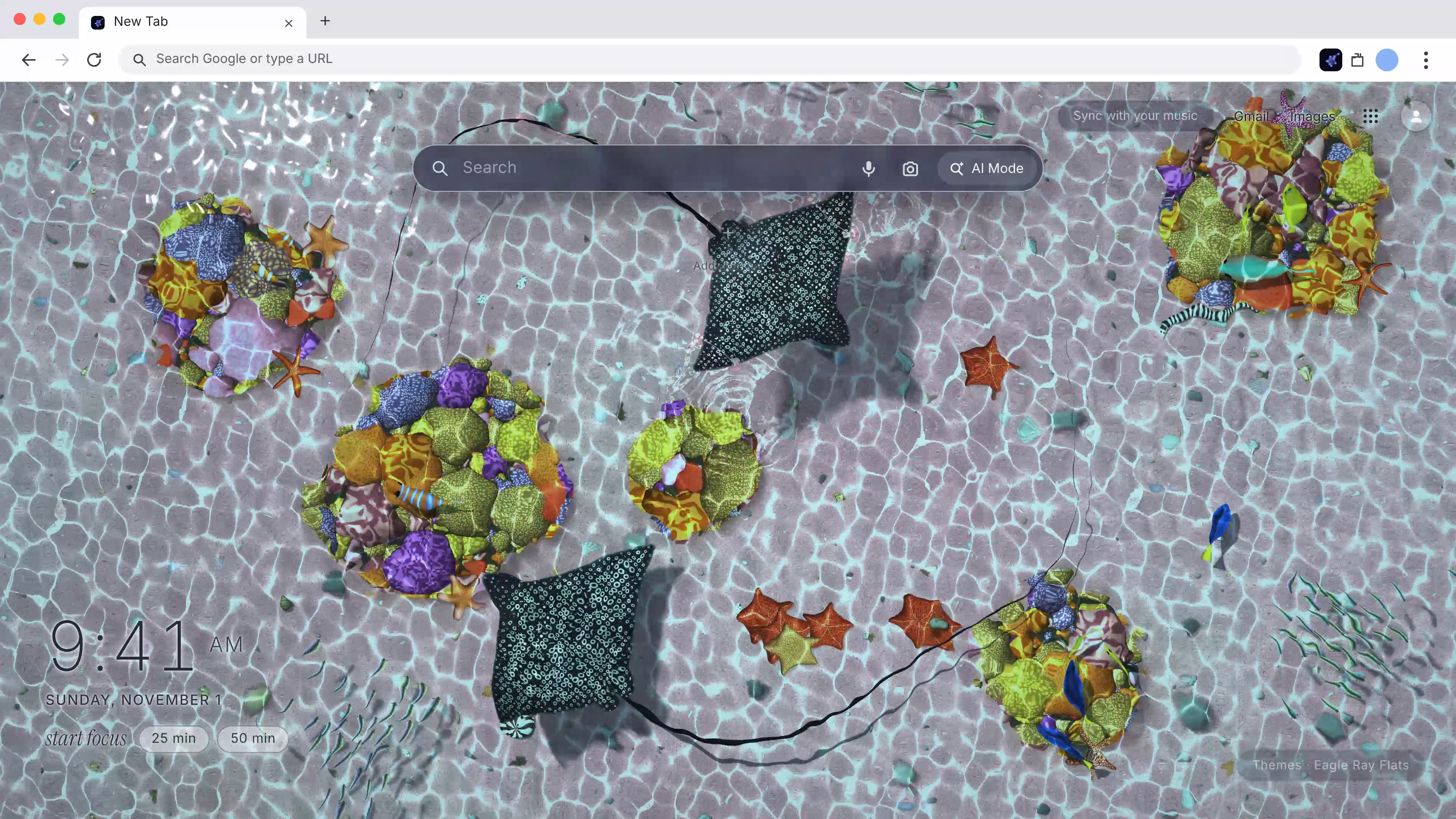
There's a focus timer built in, too. You pick 25 or 50 minutes, work, then take a short break. The scene is the break, and the timer brings you back.
The tab I look at most is Koi Pond. I love how the fish react to my pointer, and you can even feed them. I'm a big fan of Eagle Ray Flats too. And I'll admit it: I love watching the little tanks in Tiny Tanks fight each other. That's the kid in me who drew space fighters in the margins.
To be honest, a moving scene isn't for everyone. If motion pulls you off task, pick one of the calmer scenes, or use it only on breaks. This is a tool for a short pause you choose, not a treatment for anything.
Try a 40-second break today
- When you notice you've read the same line twice, stop.
- Look at something calm and alive for about 40 seconds: a window, a plant, or a scene on your screen.
- Let your mind wander on purpose. Don't check messages.
- Come back to the task.
If you'd like a scene waiting on every new tab, Ambient New Tab has five free ones.
Add Ambient New Tab to Chrome, free
I'm not a doctor, and this isn't medical advice. If ADHD affects your work or life, talk to a professional you trust.
Frequently asked questions
How long should a micro-break be?
Researchers usually define a micro-break as 10 minutes or less. In a 2015 University of Melbourne study, just 40 seconds of looking at a green, flowering roof helped people make fewer mistakes afterwards. A 2022 review of 22 studies found that longer micro-breaks tended to help performance more, so treat 40 seconds as a minimum, not a limit.
Does looking at nature help you concentrate?
Research suggests it can. In the 2015 study, students who looked at a green roof for 40 seconds made fewer mistakes and kept their concentration better than students who looked at a bare concrete roof. That is one study, but it fits wider research on nature and attention.
Is daydreaming bad if you have ADHD?
Not necessarily. Early research from Radboud University, presented in 2025 and not yet peer-reviewed, linked ADHD traits to higher creativity. Letting your mind wander on purpose was tied to imagination, while drifting off without meaning to was tied to everyday struggles. If ADHD affects your work or life, talk to a professional.
Can Ambient New Tab help with ADHD?
It is not a treatment for ADHD or anything else. It puts a calm, living scene on every new tab and includes a 25- or 50-minute focus timer, so a short break is always one tab away. I built it for my own ADHD brain, and it is free to try with five scenes.
Sources
- Lee et al., 40-second green roof views sustain attention, Journal of Environmental Psychology, 2015
- Albulescu et al., "Give me a break!" micro-break meta-analysis, PLOS ONE, 2022
- McMillan et al., Ode to positive constructive daydreaming, Frontiers in Psychology, 2013
- ADHD wandering minds linked to increased creativity, HealthDay, October 2025